

Informing Resilient Agriculture
How can we help you?
Please complete the survey to help us understand your needs.
With your permission, we will be in touch to discuss how ADAPTA-IF can support your business.
What is ADAPTA?
An Information Factory (IF) for Adaptive Agriculture.
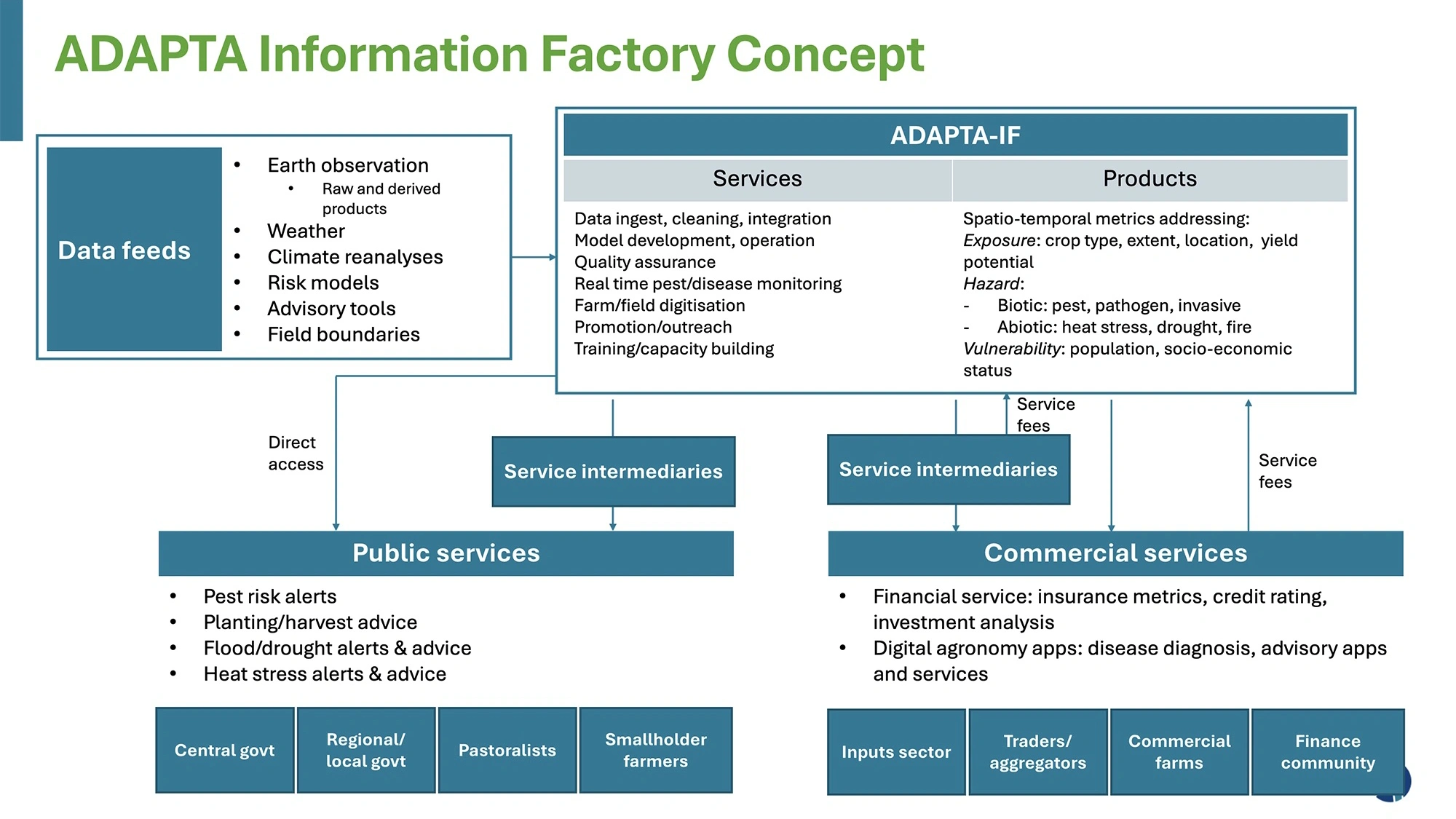
Funded by the European Space Agency (ESA), IFs are intended to overcome the ‘last mile’ problem accessing and utilising EO , climate and weather data for agricultural decision making. Building on advanced cloud-based computing infrastructure, ADAPTA-IF enables a variety of supply chain operators access and use the climate related data and information products they need to make informed adaptation decisions.
For example:
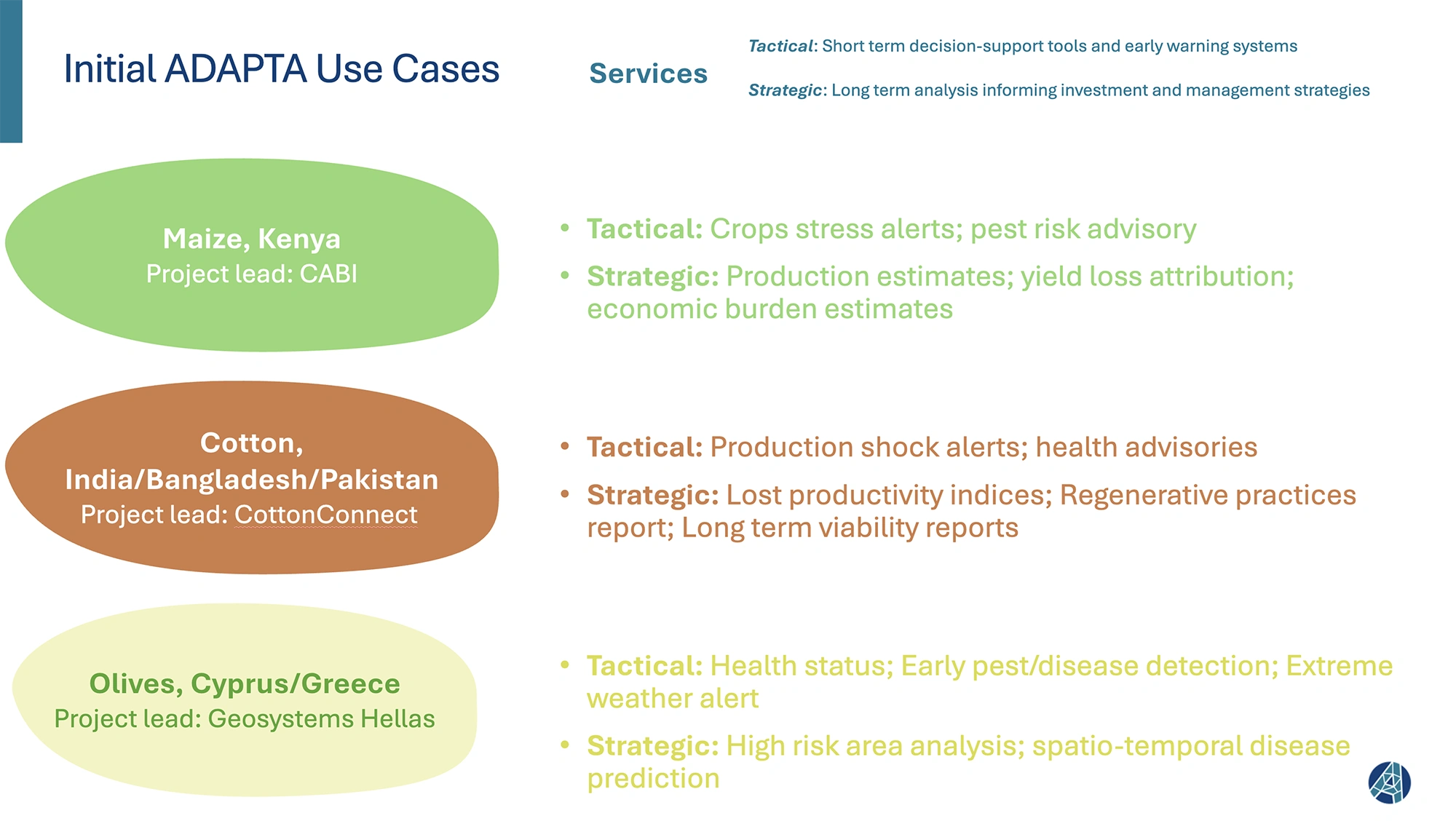
- A maize farmer is worried about Fall Armyworm wants advice on when to treat her crop with sustainable biopesticides. ADAPTA-IF response: use temperature-driven pest development models. Combined with crop status data to provide optimum ‘window of opportunity’ to recue pest damage.
- A major brand sourcing cotton from Bangladesh wants to estimate the economic impact of extreme temperatures. ADAPTA-IF response: deliver a spatially-explicit, country-wide 30 year history of wet bulb temperature and lost labour productivity.
- Olive growers across Europe are concerned about the spread of a new pathogen. ADAPTA-IF response: Combine climate-driven hazard modelling with maps of olive production to create long term risk indices that form the basis of a new parametric insurance product.
The potential for EO and weather driven insights are endless. ADAPTA-IF is designed to accelerate the time to development of data products and services tailored to specific supply chains, risk and customers.
Aims and objectives
Agriculture highly exposed to climate change. Adapting to those changes requires the best available intelligence and decision support tools.
ADAPTA-IF aims to provide:
Reliability
- Using best in class data sources
- Quality assured, published meta-data
Flexibility
- Early warning systems need timely, real-time data
- Long term investment planning requires long time series, and projections
Integration
- Tools to combine, process and analyse data of different provenance, format and type
- Reducing barriers to access
Partnership
- Open to a variety of input data suppliers
- Develop service intermediary partnerships to address specific market verticals
Market oriented
- Developing tools for multiple agri supply chains
- Flexible business models
Partners
Funded by ESA

Project partners



Case studies
How can we help you?
Please complete this survey to help us understand your needs. With your permission, we will be in touch to discuss how ADAPTA-IF can support your business.
Sustainable crop production
Pest and disease management
Example projects
 Sustainable crop production
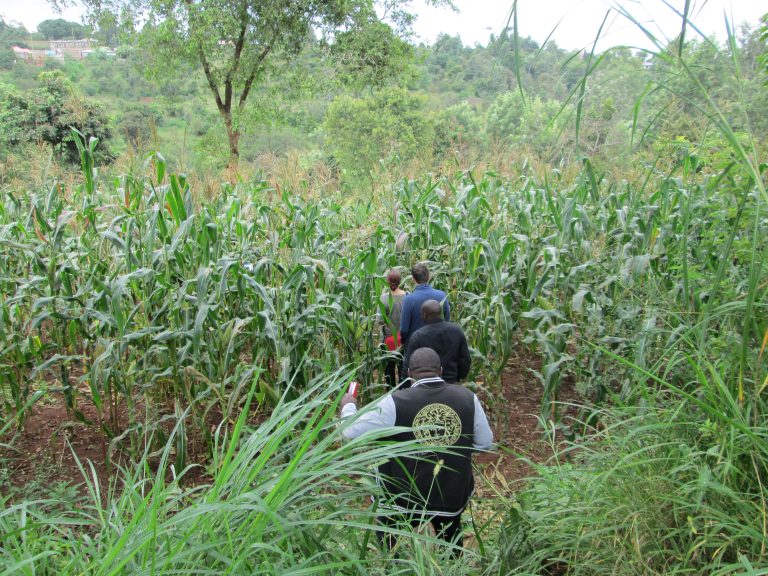
Assimila is working with partners to develop operational crop forecasting systems using crop modelling, coupled with Earth observations and weather data.
A combination of satellite data from optical sensors and synthetic aperture radar (SAR) can give information down to around 10 m. Such information helps us fine tune crop model output to provide more accurate forecasts at the field scale.
Example projects:
Pest and disease management
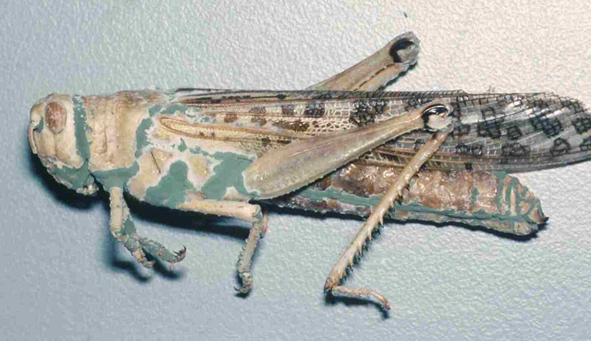
Crop pests and diseases are estimated to cause global crop productivity losses of up to 40%. The development of these pests and diseases is strongly linked to environmental conditions, with temperature, rainfall and humidity amongst some of the most important factors.
Traditionally, methods to analyse such environmental factors have used data obtained from a network of in situ meteorological stations, but their sparse geographic coverage limits their use. Earth observation (EO) data overcomes these issues and can provide well-calibrated and spatially continuous data.
Working with CABI, Assimila is combining Earth observations and meteorological data with biological models to assess pest risk and to provide advice on the most suitable timing for the application of biopesticides.
Example projects:
Innovative use of multi-sensor satellite data can provide site-specific field conditions giving near real-time monitoring of crop growth, as well as historical crop information and weather conditions. With climate scenarios we can assess the possible impacts of climate change. We are also coupling Earth observation data with biological models of pest lifecycles.